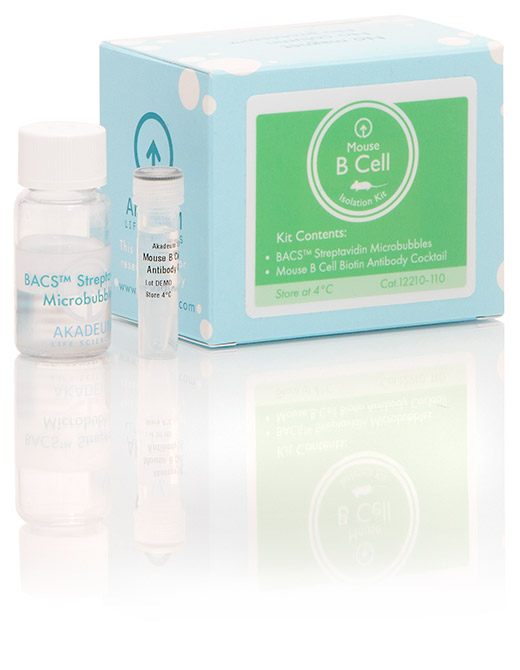
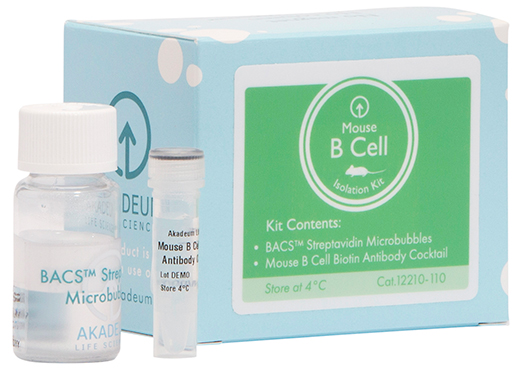
The Mouse B Isolation Kit was developed with BACS™ Microbubbles for the enrichment of untouched B cells. Unwanted cells are depleted through negative selection.
This kit can process up to 1 billion cells
Fast & easy workflow enriches splenocytes for B cells in 30 minutes
No magnet, no column, no harsh chemicals
Microbubble enrichment maintains cell health and physiology
The Mouse B Cell Isolation Kit delivers a high purity population of murine B cells that are ready for downstream use. The BACS™ Microbubble workflow is exceptionally gentle on cells, helping to maintain the health and physiology of B cells during enrichment.
Mechanism of Action: The Mouse B Cell Isolation Kit uses a negative selection method to remove unwanted cell populations and effectively enrich B Cells. Unwanted cells are labeled with an optimized cocktail of biotinylated antibodies targeting CD3, CD4, CD8a, CD11b, CD11c, CD49b, CD90.2, CD105, Gr1, Ter119.
How it Works: The biotinylated antibody cocktail is added to the sample to label unwanted cells. BACS™ Microbubbles are added to the sample and bind to the antibody-labeled cells. Microbubbles bound to the undesired cells, quickly and gently float the undesired cells to the surface. B cells, the cells of interest, are pelleted through centrifugation. Microbubble-bound cells and supernatant are easily aspirated away, leaving untouched and enriched B cells healthy and ready for downstream use.
Additional Information:
Storage: 4°C
Cell Type: B cells
Sample Species and Source: Mouse spleen.
Cell Separation Method: Negative Selection
Capacity: 1 billion cells
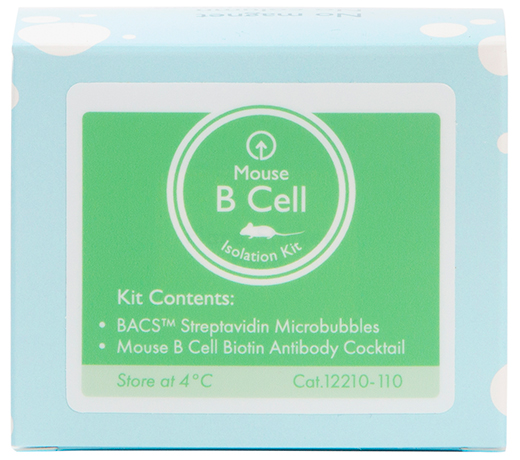
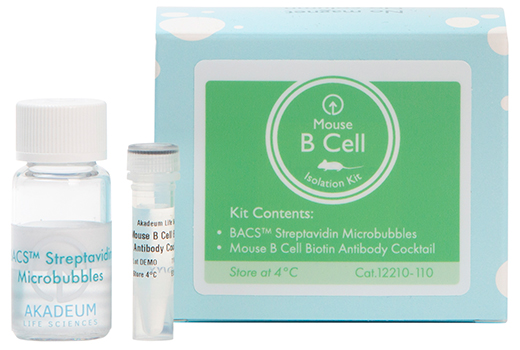
This kit comes with:
BACS™ Streptavidin Microbubbles
Mouse B Cell Biotin Antibody Cocktail
Separation Buffer (Ca2+ and Mg2+ free PBS containing 2 mM EDTA, 0.5% biotin-free BSA)
5mL Tubes
For best results, the following supplies are recommended:
20 rpm tube rotator for mixing
Centrifuge with swinging bucket rotor
Vacuum aspirator
30 μm cell strainer
Key Features
The Mouse B Cell Isolation Kit leverages Akadeum’s novel Buoyancy Activated Cell Sorting (BACS™) technology to deliver a highly enriched population of healthy, viable B cells. BACS™ Microbubbles are fast, easy-to-use, and gentle on cells. The BACS™ Microbubble isolation platform minimizes handling by enabling single-tube processing, limiting unnecessarily loss of cells. The B cell isolation protocol is fast and simple, taking just 30 minutes and not requiring magnets or columns. The result is a population of highly pure B cells that are healthy and ready for downstream use.
Elevated Solutions for Sample Preparation:
Exceptionally gentle B cell enrichment
Fast and easy workflow; complete in ~30-minutes
Single tube processing that minimizes sample handling and loss of target cells
Elegant in Simplicity, Powerful in Application
BACS™ Microbubble technology harnesses the power of buoyancy to provide a fast, easy, and gentle cell isolation. Our novel technology couples performance, ease, and quality, bringing cell separation to the next level.
Experience the benefits of a microbubble workflow. Akadeum’s Microbubbles Are:
Magnet-free: Cells are not subjected to harsh magnetic forces.
Column-free: BACSTM workflow is easy-to-use and does not require onerous and expensive columns.
Gentle on cells: Harnessing the power of buoyancy, BACSTM Microbubbles swiftly and gently remove unwanted cells via floatation.
Fast, reliable, and scalable: The simple BACSTM Microbubbles protocol delivers reproducible results and can be easily scaled for larger volumes.
Looking for Answers?
At Akadeum Life Sciences, our team is committed to your success. We thrive on problem-solving and are dedicated to helping the researchers we work with see exceptional results. If you’re interested in leveraging the microbubble platform to overcome existing hurdles in your sample preparation processes, we want to hear from you! You can speak directly to our team of scientists who are available to help you with an optimized workflow that takes advantage of our microbubble technology and solves long-standing headaches in sample preparation. Schedule a call today, we’d love to start a conversation!
Data
Untouched B cells were isolated from splenocytes using the Mouse B Cell Isolation Kit (12210-110). Isolated cells were labeled with CD3-APC and CD19-FITC. The fluorescently labeled cells were analyzed by flow cytometry. Debris and dead cells were excluded from analysis.
Workflow in Use: Mouse B Cell Isolation
The Mouse B Cell Isolation Kit allows researchers to obtain highly-enriched, high-quality B cells using our exceptionally gentle workflow that does not sacrifice purity for quality. Akadeum’s negative selection process maintains cell health and physiology, and the isolated cells retain their activation and differentiation potential. The microbubble isolation process does not disturb B Cell Receptors (BCRs) or skew the isolated population.
1. Can I do back-to-back isolation to improve purity?
Yes. This can be specifically helpful when using the Dead Cell Removal Microbubble Kit or the Human Red Blood Cell Depletion Microbubbles.
2. Which cell types can be processed using Akadeum’s Dead Cell Removal Microbubble Kit?
Akadeum’s Dead Cell Removal Microbubble Kit utilizes Annexin V-coated microbubbles to selectively bind phosphatidylserine, a marker exposed on the surface of cells undergoing apoptosis. This technology enables efficient removal of apoptotic cells across various cell types where apoptosis is actively occurring.
3. Can the Dead Cell Removal Microbubble Kit be used if the sample is under 35% viability?
Although the initial cell viability is below the recommended threshold, successful outcomes have been achieved by performing the protocol twice on such samples.
General Questions
Are Akadeum microbubbles hollow silica spheres?
Yes, Akadeum’s microbubbles are hollow silica spheres. Silica is a material that has extensive precedence for use in therapeutics and diagnostics.
Are antibodies directly attached to the microbubbles?
Only specific kits, such as our Dead Cell Removal (DCR) and RBC microbubble kits, use antibody-coated microbubbles. Most Akadeum microbubble products are not coated with antibodies; instead, a biotinylated antibody cocktail is provided to use with the streptavidin-coated microbubbles.
What is buoyancy-activated cell sorting (BACS)?
BACS is Akadeum’s proprietary cell separation technology that uses buoyant microbubbles to isolate specific cell populations utilizing only the power of gravity.
What are microbubbles?
Akadeum’s microbubbles are hollow silica spheres that are on average 12 microns.
How big are microbubbles?
Microbubbles average 12 um in diameter. Learn more about microbubbles technology.
How many cells can a microbubble lift?
Microbubbles can carry as many as four cells.
What is the Separation Buffer?
Ca2+, Mg2+ free Dulbecco’s PBS containing 2mM EDTA, and 0.5% bovine serum albumin (BSA). BSA must be biotin free to not interfere with kit performance.
After sitting in the refrigerator, all the microbubbles have separated out of solution. Is there something wrong?
No, this is normal due to the buoyant properties of microbubbles. The solution will need to be mixed well before every use. If processing multiple tubes, mixing between tubes is necessary.
I don’t have an aspirator/vacuum available in my lab, can I still use Akadeum microbubbles?
Aspiration is the best and easiest way to remove the microbubble layer after centrifugation. Pipetting off the bubble layer is not very effective. Vacuum pumps are available from a variety of vendors.
How are Akadeum’s kits shipped?
Kits are shipped on ice packs with overnight delivery.
I have additional technical questions, who should I contact?
Please email all technical questions to techsupport@akadeum.com or check out our chatbot!